

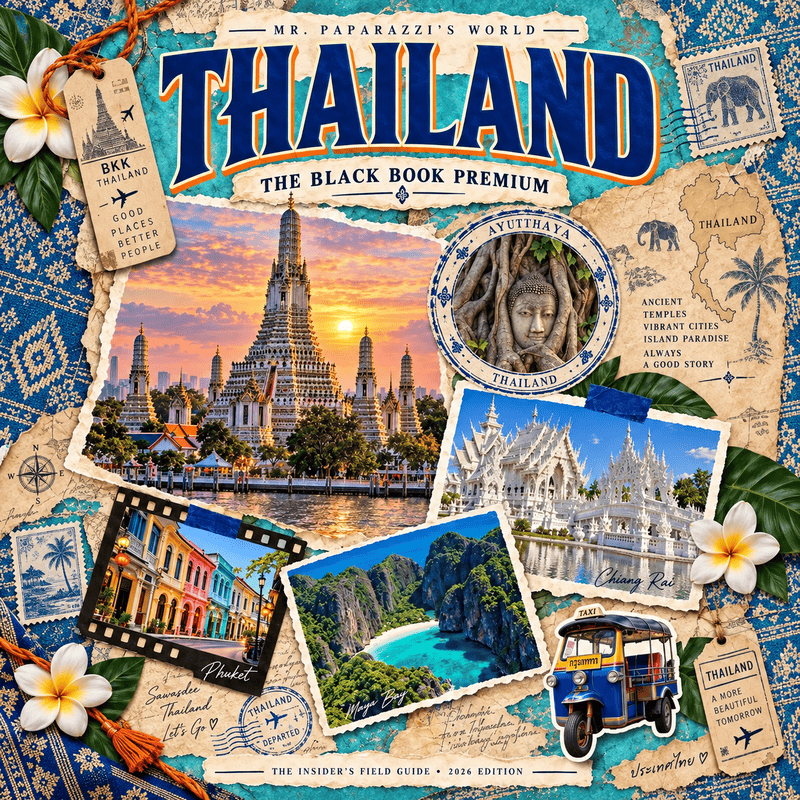
The BlackBook Premium Thailand
27 $AUD
Short Description
The Black Book Premium — Thailand is 68 field-verified venues across 18 regions, built from what actually happened, not what got pitched to me. Real transport hacks, the scams still working on thousands of travellers a week, and four hidden corners of the country most guidebooks never mention.
Product's Description
What Actually Matters Before You Land
Thailand is, genuinely, the easiest country in Southeast Asia to travel badly. The infrastructure is so smooth you can coast through on autopilot for two weeks and see almost nothing real. A handful of habits fix that before it happens.
- Money: 7-Eleven is on every second corner and takes cards, so stop carrying stacks of cash for no reason. When you do use an ATM, withdraw the maximum in one go — the roughly 220 baht fee is charged per transaction, not per baht, so five small withdrawals cost you five times over. Keep small notes for street food and longtail boats. Tipping isn’t expected here the way it is at home — rounding up is plenty.
- Temples: Shoulders and knees covered, always, no exceptions for heat. Shoes off before you go in, and never point your feet at a Buddha image. Women don’t touch monks or hand them anything directly — put it down and let him pick it up. And whatever a friendly stranger tells you at the gate, the temple is not closed today — that line is almost always the opening move of a scam.
- Timing: November to February is genuinely peak season and worth fighting the crowds for. March–April flips that in the north, where seasonal burning turns the air in Chiang Mai and Chiang Rai genuinely unhealthy, while the south stays fine. Mid-April brings Songkran, which shuts the country down for a week of nationwide water fights. If Chiang Mai’s Yi Peng lantern festival is on your list, book accommodation months out, not weeks.
The Traps Still Working on Thousands of People a Week
None of what follows is subtle. All of it still catches people daily, because it’s built to.
Tiger attractions, every single one of them, run on sedation, chains and concrete — your entrance fee is the entire business model. Elephant riding is a similar story: an elephant’s spine was never built to carry a howdah safely, and the only ethical version of that experience is a sanctuary where you feed and observe rather than ride. Jet ski rental scams follow a predictable script too — you return the machine, they “discover” pre-existing damage, and a very convenient officer arrives to help mediate a settlement. Film the jet ski before you take it out, or skip renting one entirely.
The Damnoen Saduak floating market gets recommended constantly and is, at this point, essentially a stage set for tour buses. Amphawa on a weekend evening is the real version of that experience, with a fraction of the crowd. And once you’re back in Bangkok, tuk-tuks are charming exactly once — after that they’re three times the Grab fare, stuck in worse traffic, with a driver quietly working commission from whichever suit shop or gem dealer he detours you past.
Four Places That Change What You Think Thailand Is
The venues above are the ones everyone eventually finds. These four aren’t, and each is only a night or two off the standard route.
| Hidden Gem | Why It’s Different | Best Time |
|---|---|---|
| Koh Kood | About as close as the Gulf of Thailand gets to unspoilt — no real nightlife, no 7-Eleven on every corner, water clearer than Krabi | Year-round |
| Koh Lipe | Thailand’s southernmost island, inside a marine park near the Malaysian border, reef straight off the beach | November–April only |
| Hua Hin | Where Bangkok’s own residents go for the weekend — royal palaces, real night markets, a beach nobody photographs for Instagram | Year-round, 2.5hrs by train |
| Mae Hong Son Loop | ~600km mountain road from Chiang Mai through Pai and back — one of the best drives in the country, for confident riders only | 4 days by motorbike |
What to Actually Eat
Skip the green curry tourist loop for a minute. Khao soi — coconut curry noodles — only really works in its northern form around Chiang Mai and Chiang Rai; Bangkok’s versions are imitations. Larb in its northern style skips the lime that southern versions lean on, and pad kra pao, holy basil stir-fried with a fried egg, is the dish Thai people actually eat daily, not the one aimed at visitors. Boat noodles near Victory Monument come in bowls so small that four servings is completely normal, and mango sticky rice is only worth ordering March through May — any other month, it’s made with imported mango and it shows.
Why Any of This Matters
I didn’t put any of this together from a desk. Every line above came from actually standing in the queue, actually renting the jet ski to see the scam run its course, actually riding the Mae Hong Son Loop on a bike that wasn’t quite up to it. That’s the entire difference between a guide written by someone chasing pageviews and one written by someone who’s paid for the mistake so you don’t have to.
That’s what sixty-eight venues and eighteen sections of field-verified Thailand adds up to — and this is a fraction of what’s actually in it.